


Yesterday morning I woke up to violent shaking caused by a magnitude 7.8 earthquake that struck off the coast of Sarangani province.
The epicenter was about 32 kilometers offshore, west of Maasim… and the damage in General Santos City was significant.
Buildings collapsed.
A Jollibee.
A donation center.
A high school in Matanao that had already been damaged back in 2019.
At least 32 people were killed and more than 200 injured, with a 1-meter tsunami recorded hitting nearby coasts.
It was the strongest earthquake to hit the Philippines since 1990.
Here in Davao, we felt it.
And like a lot of people, my first instinct was to check PHIVOLCS.
It was a strong earthquake indeed.
One of the strongest in recent Philippine history.
It also made me realize one thing… I actually don’t fully understand how PHIVOLCS detects and registers these things.
So, after things had calmed down, I did some reading.
Here’s what I learned.
PHIVOLCS
PHIVOLCS, or the Philippine Institute of Volcanology and Seismology, is a national institution dedicated to providing information on the activities of volcanoes, earthquakes, and tsunamis, along with specialized information and services for the protection of life and property.
It is a service agency under the Department of Science and Technology.
They’re the ones who publish the earthquake bulletins, issue tsunami warnings, and tell us how strong something was felt in our area.
The actual detection starts long before any bulletin gets published…
You see, the Philippines has a network of seismic stations spread across the country. The central operating station is at the PHIVOLCS main office in Diliman, Quezon City. All information is received at the Data Receiving Center, or DRC, which is operated 24 hours a day, 7 days a week by the Seismological Observation and Prediction Division.
The network includes both manned and unmanned stations. Like Apo Agua…
Data from the unmanned stations is transmitted continuously through satellite communication, while data from Global Seismic Network stations comes through high-speed internet.
This allows the DRC to monitor earthquake events not just in the Philippines but worldwide.
The DRC uses two automatic earthquake location computers called SeisComP and Hydra, which continuously receive, process, and evaluate seismic data in near real-time. On average, the Philippine Seismic Network records about twenty earthquakes per day.
Twenty earthquakes.
Every single day.
Most of them too small to feel.
But they’re all being recorded.
How Does a Seismograph Actually Work?
A seismograph… or seismometer, which is the more precise term for the sensor itself… works on a beautifully simple principle. It detects ground motion.
I know about this because I learned this back when I was in elementary school. So… I’m gonna rely on ye old stock knowledge to try and explain how it works…
Anyway… inside the device is a heavy mass suspended on a spring or pendulum. When the ground shakes, everything around that mass moves… but the mass itself, because of inertia, tends to stay still for a brief moment.
That difference in movement between the stationary mass and the moving ground is what gets recorded.
Older seismographs recorded this as a line on paper wrapped around a rotating drum.
I assume that modern ones convert it into digital data.
Ooohhhh… I wonder if I’m right… anyway… I’ll edit this to correct the info if I’m wrong… so don’t worry, hehehe if I was wrong, you’d never know…
This one I am kind dof foggy on so… I had to go to my trusted sources… Google and Wiki… and others
There are two types of waves a seismograph detects.
- P-waves (primary waves) are the first to arrive and travel through the earth as compression waves, like sound. They’re faster but less destructive.
- S-waves (secondary waves) arrive next and move the ground sideways, which is what causes most of the shaking damage.
The time difference between when P-waves and S-waves arrive at different stations is what allows scientists to triangulate exactly where an earthquake originated.
Gotta learn this stuff because Lyle is bound to ask me these things any day now…
PHIVOLCS has upgraded its seismic network to include both accelerometers and broadband seismometers, which allows for both intensity measurement and focal mechanism determination, meaning they can now figure out not just where and how strong, but how the fault actually moved.
That’s how PHIVOLCS initially reported yesterday’s earthquake at magnitude 7.0 before revising it upward to 7.8 as more data came in from the network.
The first reading comes fast.
The refined reading comes after more stations report in.
What About Home Seismic Devices?
Now this is the one I am most excited about and what surprised me was you can now get a personal seismograph for your home!
A real one!
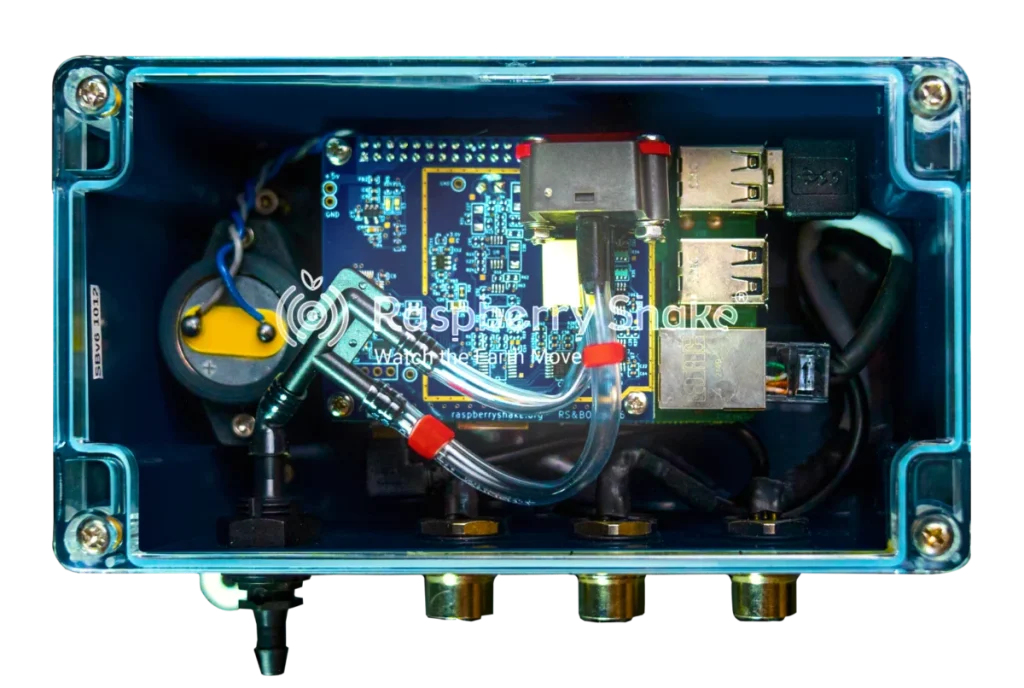
The Raspberry Shake is a desktop seismograph designed for the earthquake-curious or the seismologist on a budget. It costs between $100 and $1,200 depending on features, and can detect local to regional earthquakes. It was developed by OSOP, a geophysical instrument company, and marketed toward hobbyists and makers but also used by professionals to supplement monitoring networks.
The Infiltec QM-4.5LV is another option designed for home, school, or office use. It can typically detect magnitude 6 earthquakes up to 4,000 kilometers away, magnitude 7 events worldwide, and magnitude 3.5 events within 150 kilometers. It connects to a PC and requires no external power, zeroing, or alignment.
For something simpler, the Quake Alarm is a wall-mounted earthquake detector designed for homes, offices, and schools. It detects the P-wave, which is the first wave to arrive before the stronger shaking, giving you a few seconds of early warning.
It has adjustable sensitivity, automatically resets after the earthquake stops, and monitors for aftershocks. A few seconds sounds like nothing. But it’s enough to get under a table.
And if you just want something on your phone first… there are seismometer apps that use your phone’s built-in accelerometer to detect ground motion. They’re not as sensitive as dedicated hardware, but they work for strong local events.
Why is this Important for You and Me?
Yesterday’s earthquake was centered in Sarangani.
We’re not that far.
And Mindanao sits on some of the most seismically active terrain in the country, with the Philippine Fault and several other active fault systems running through and around the island.
The Philippines is one of the world’s most disaster-prone countries, sitting on the Pacific Ring of Fire, an arc of seismic faults around the Pacific Ocean that produces frequent earthquakes and volcanic activity.
This isn’t going to stop.
The question is just how prepared we are when the next one hits.
… and just in case… here’s what you can do in the event of a devastating Earthquake, a destructive Tsunami or an unforgiving fire…
Knowing how PHIVOLCS works helps.
Knowing what a seismograph does helps.
And honestly… knowing that you can now put a real earthquake detector in your own home for a reasonable price is something worth thinking about, especially if you have kids and you live in an area like ours.
Stay safe out there. Check on your neighbors. And if you felt it yesterday… you’re not alone.
Useful links, not affiliate links:
- PHIVOLCS real-time earthquake updates: phivolcs.dost.gov.ph
- Raspberry Shake home seismograph: raspberryshake.org