

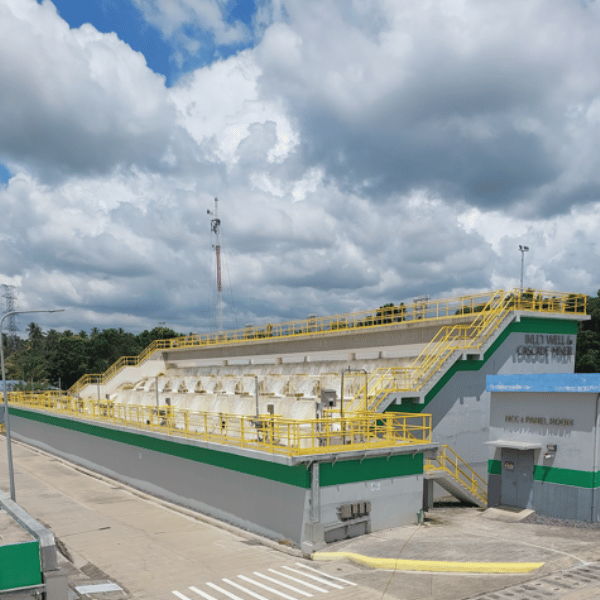
I stood on a catwalk inside the Apo Agua facility, gripping my cellphone with one hand while holding on for dear life to the oversized umbrella with the other, trying not to look down… and trying to look down at the same time because the water rushing below was hypnotic.
Loud.
Cold mist in the air despite the blazing sun overhead.
The kind of scale you don’t expect until you’re standing right in the middle of it.
That was my visit to the Apo Agua facility with the Davao Bloggers Society.
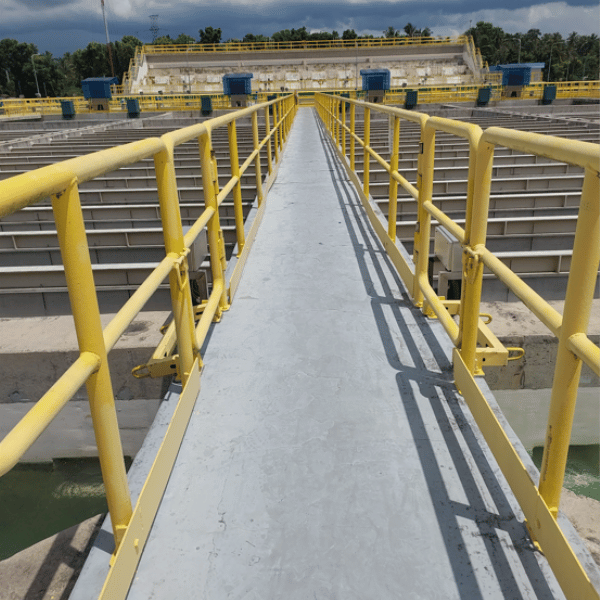
And beyond the mild terror of tat narrow catwalk, what I came away with was a much clearer picture of something most of us in Davao never think about: where exactly the water in our taps comes from, and what happens to it before it gets there.
Stage 1: The Source — Tamugan River
Everything starts at the Panigan-Tamugan River up in the mountains of Marilog District, about an hour from the city if you drive fast. Or 30 minutes if you’re my brother-in-law who drives faster.
At full capacity, the Davao City Bulk Water Supply Project delivers 300 million liters of water per day from the Tamugan River to the Davao City Water District.
That’s the starting point.
A river in the mountains, fed by rainfall and the watershed forests above it, becoming the primary water source for over a million people below.
The raw water facilities include an intake weir, a desander, and an 8-kilometer conveyance pipeline that moves water from the river toward the treatment facility, as well as a flume bridge that carries the water flow across terrain.
The intake weir is essentially a low dam structure that diverts river water into the system without fully blocking the river’s natural flow.
From there, the water enters a desander, which is exactly what it sounds like… a chamber that slows the water down enough for heavy sediment like sand and grit to settle and separate out before the water moves any further.
This is the first rough cleaning stage.
The water isn’t treated yet, just physically separated from the coarsest particles.
From the desander, the water travels through that 8-kilometer conveyance pipeline down toward the treatment plant.
Standing there and realizing that water was moving through that much pipe, by gravity, without pumping… was one of the most incredible engineering moments I’ve witnessed in real life.
Stage 2: The Treatment Plant
Once the raw water reaches the treatment facility in Baguio District, the real work begins.
The facility uses fully automated and centralized control systems that enable streamlined and highly efficient operation and monitoring of its water treatment and distribution processes.
Nobody is manually operating valves and gauges by hand.
The whole system is monitored and controlled digitally, which means consistent water quality around the clock.
The treatment process follows the standard steps used in modern surface water treatment plants:
Coagulation and Flocculation — Chemicals are added to the raw water that cause the tiny suspended particles that passed through the desander to clump together into larger, heavier clusters called floc.
Think of it as making the invisible dirt… visible and heavy enough to remove.
Sedimentation — The water moves into large settling tanks where those heavier floc clusters sink to the bottom under gravity. The clearer water above is drawn off for the next stage.
Filtration — The clarified water passes through filtration media, typically layers of sand and other materials, that catch the finer particles that didn’t settle out. This is where the water starts looking genuinely clear.
Disinfection — Finally, the treated water is disinfected, typically with chlorine or similar agents, to eliminate bacteria, viruses, and other microorganisms. This is the stage that makes water safe to drink.
After treatment, the water meets Philippine National Standards for Drinking Water before it ever leaves the facility.
Stage 3: The Energy Behind It All
Here’s the part that still amazes me.
The Apo Agua facility is designed using the water-energy nexus concept, a first in Southeast Asia, enabling the facility to fully power itself with an integrated Hydroelectric Power Plant. The same water used to generate power is then treated and supplied to the DCWD.
The river powers the plant that cleans the river water. And then after treatment, the water moves to the city through a largely gravity-fed distribution system, meaning no massive energy-hungry pumps pushing water uphill. The elevation of the source does the work naturally.
It’s a closed loop of sorts.
Clean energy powering clean water.
Stage 4: From Apo Agua to Your Tap
Once treated, the water is delivered through treated water pipelines to the Davao City Water District. From there, DCWD takes over the distribution side, which involves tapping and interconnecting pipes, installing reservoirs, and laying distribution lines throughout the city.
Apo Agua’s job ends at the bulk delivery point. DCWD’s job is getting it through the network of pipes under Davao’s streets and into homes, schools, hospitals, and businesses across the city.
And Then There’s You
All of that infrastructure… the river, the desander, the 8-kilometer pipeline, the treatment plant, the hydro power, the gravity distribution, the DCWD network… it all ends at your glass.
And whether you drink enough of it is another question entirely.
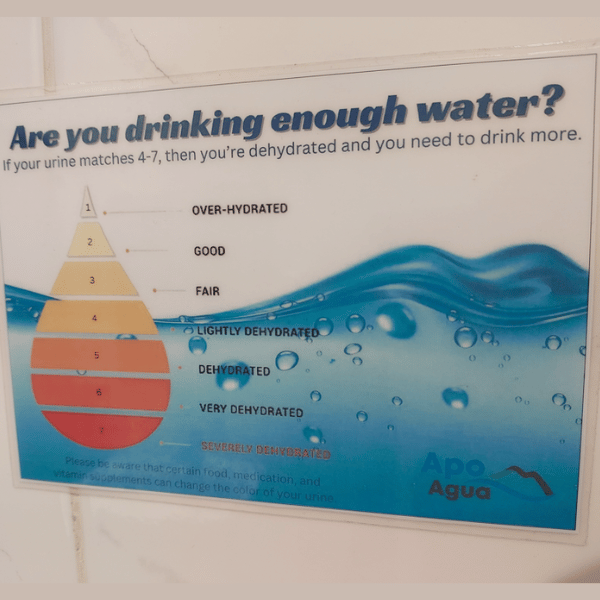
Want to know your hydration level? Check this article out: Are You Drinking Enough Water? What Your Urine is Telling You
One of the simplest ways to check if you’re drinking enough water is to look at the color of your urine. Pale yellow means you’re well hydrated. Dark yellow or amber is your body telling you to drink more.
The water is there.
Clean and available.
The rest is up to you.
Drink up.
For more information about Apo Agua and the Davao City Bulk Water Supply Project, visit apoagua.com or follow them at @ApoAguaInfra on Facebook.