

Before I start this article about what a Suzuki Multicab is, let me start by saying: Happy birthday Domz.
47 years old.
Can you believe that?
It feels like just yesterday we were younger and dumber and somehow made it work… and I remember that Suzuki multicab your mom bought with her retirement fund in Tacloban. I think about that little truck more than I probably should.
I see multicabs on the road here in Davao… and you see them everywhere, in the market, hauling stuff along the highway, parked outside sari-sari stores with the engine running…
And when I see one, I sometimes think about that multicab you owned in Tacloban City.
So for your birthday, I figured I’d write about the one vehicle I associate most with you.
Even if I kind of hate driving it.
More on that later.
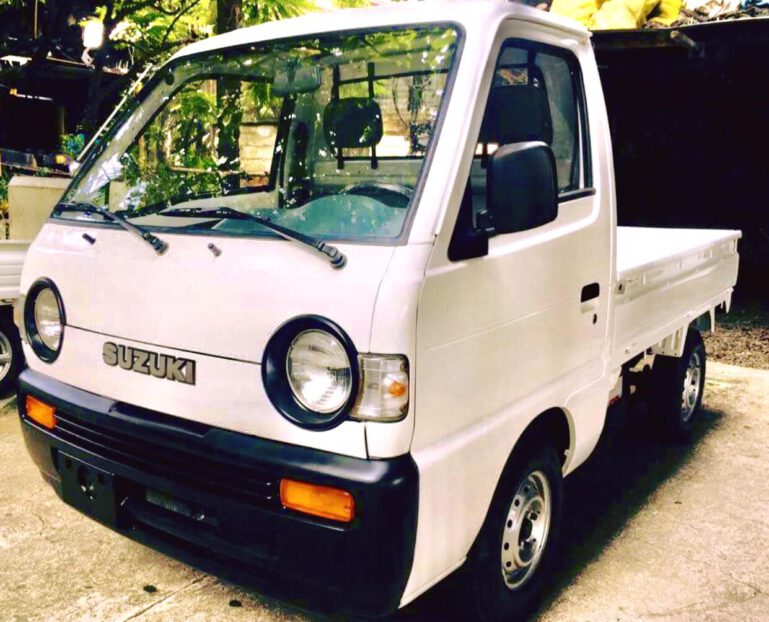
For those who don’t know, the Suzuki Multicab is what Filipinos call the local version of a Japanese kei truck.
These are tiny commercial vehicles originally made for Japan’s domestic market, where the rules require cars to stay small to get certain tax and parking benefits.
Japan has very strict size and engine limits for these kei vehicles… so they built these incredibly compact little trucks that are just enough for city and light hauling use.
When these units reach the end of their useful life in Japan, many are exported as surplus vehicles to countries like the Philippines, where they get a second life as the backbone of small businesses, public transport, and farm work.
Here in the Philippines, especially outside Metro Manila… in places like Davao, Tacloban, General Santos, and all over the regions… the multicab is everywhere.
It’s a working-class hero.
Small, cheap to run, easy to fix, and you can do almost anything with the body.
Dropside for hauling.
Passenger van for routes.
Food cart base.
School vehicle.
You name it, someone has already done it with a multicab.
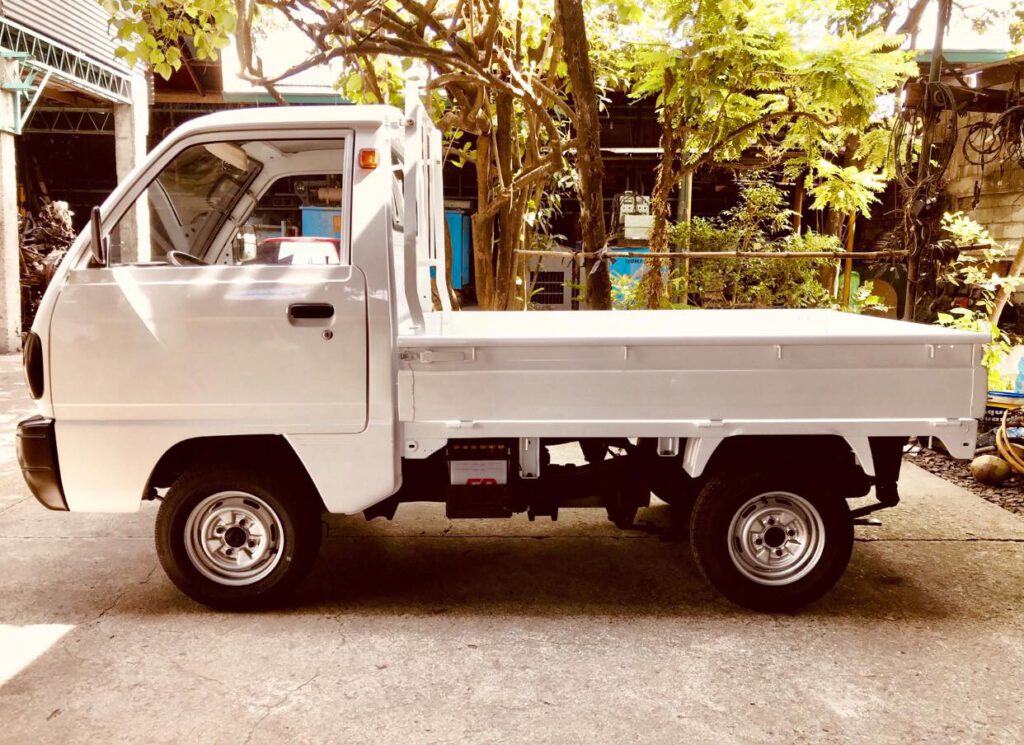
A tiny truck.
That’s really what it is.
The cab sits right on top of the front wheels (what engineers call a “cab-over” design) which gives it that very upright, almost cartoonish boxy look. No hood sticking out in front of you. The engine is basically underneath or behind the seat area.
It’s not a pretty vehicle.
Nobody is buying a multicab because it’s handsome.
But there’s something about it that is genuinely charming in a rough, honest, working-vehicle kind of way. It looks like it was designed to work, not to impress.
And in a country where most people are just trying to make a living, that kind of honesty in a vehicle design is actually… kind of nice.
Domz’s mom’s multicab was white. Or maybe it was a very faded off-white that used to be white.
These things weather quickly.
But it had character.
Under the (Very Small) Hood
The surplus models you’ll find in the Philippines, the ones that are most common on the market, typically run on a 660cc engine… specifically the F6A or the K6A-EFI gasoline engines. Yes. 660cc.
That’s smaller than some motorcycle engines. The transmission is usually a 4-speed or 5-speed manual.
Now before you laugh… that tiny engine is actually what makes the multicab so economical. Fuel costs are very low. Maintenance is cheap because the engine is simple and mechanics everywhere know how to work on it. Parts are available in almost every auto supply shop in the Philippines.
The newer, brand-new option is the Suzuki Carry, which is the modernized authorized alternative. It uses a bigger 1.5-liter gasoline engine and starts at around ₱614,000 for the base chassis cab version.
That’s for brand new.
For a reconditioned surplus multicab… you’re looking at roughly:
| Body Type | Estimated Price |
| Standard body | ₱175,000–₱185,000 |
| Extended body | ₱220,000–₱230,000 |
| Dropside with canopy | ₱185,000–₱195,000 |
Those prices are why the multicab remains one of the most popular small commercial vehicles in the country. You can start a small business with one of these for less than ₱200,000.
How It Drives
I don’t like driving multicabs.
The driving position is… awkward. Because of that cab-over design, your legs are positioned differently than in a normal car. The accelerator pedal sits at a weird angle and… I always get foot cramps.
Every time.
My right foot ends up in this unnatural position and after maybe 20 minutes I’m already uncomfortable.
Also they are slow.
Very slow.
The 660cc engine is great for city errands and light hauling but you are not overtaking anyone on the highway.
You are not merging confidently into fast traffic.
You are puttering along at a reasonable city pace and that is your life now.
And they’re small inside.
If you’re taller than average (which I’m not exactly but still), you will hunch.
The headroom is limited, the cab is tight, and sitting in the driver’s seat for more than an hour is… very uncomfortable.
But look… for what it’s designed to do?
Short city trips, market runs, hauling goods from A to B within a few kilometers?
It actually does that job perfectly well. It’s not trying to be a highway vehicle.
It knows what it is.
And it sticks to its lane very well.
Practicality for Philippine Life
This is where the multicab genuinely shines.
For small businesses in Davao especially… say you’re running a small trading business, you do deliveries around the city, you need something to carry goods from the market to your store… the multicab makes so much sense.
It’s not just for businesses either.
In smaller cities and municipalities, multicabs serve as informal public transport.
Fill it with passengers, charge a fare, run a route.
Some are converted into passenger vans with proper seating and even airconditioning inside (the van body types especially).
The 4×4 variants exist too for those who need to go into rougher terrain.
Farm roads, dirt paths, highland areas.
The 4×4 multicab is actually a serious little off-road tool given how light it is.
For families?
Honestly, not really ideal for family use as a primary vehicle.
It’s cramped, it’s slow, and it’s not comfortable enough for a long family trip.
But as a second vehicle for business use or farm work alongside the family car?
It makes a lot of sense economically.
Pros & Cons
Pros
- Extremely affordable entry price (used units under ₱200,000)
- Very low fuel consumption (660cc engine sips gas)
- Cheap and easy to maintain nationwide
- Highly versatile body options (dropside, van, passenger, flatbed)
- Available in 4×4 for rough terrain
- Parts available almost everywhere in the Philippines
- Can be used as base for a small business immediately
Cons
- Very slow on open roads and highways
- Awkward cab-over driving position (foot cramps are real, ask me)
- Small and cramped interior, not comfortable for tall riders
- 660cc engine means you will never feel confident overtaking
- Surplus units can have hidden issues depending on the source
- Not really a family vehicle for comfort or safety standards
- Weather resistance of surplus units varies widely
So yeah.
That’s the multicab.
Smelly, slow, cramped, foot-cramping little kei truck that I somehow have a warm feeling about every time I see one on the road.
Happy 47th birthday Domz.
You are, and will always be, the person I associate most with the Suzuki Multicab.
I mean that in the best way possible.